Place, Memory, and Interpretation in My Abstract Paintings
One of the reasons I love open studio events and collectors nights, is the opportunity to talk face-to-face with people about my work. Those in-person conversations always help me think and speak more clearly about what I paint and why.
One of the questions I hear most often when people encounter my work, “Do your abstract paintings represent specific places or ideas?” It is a thoughtful question, and one that gets to the heart of how abstraction functions in my practice.
My simple answer is “Yes and no.” (No surprise there, right?) It’s true: some paintings are closely informed by particular landscapes or experiences, while others are intentionally open, leaving room for interpretation to unfold between the viewer and the work.
For me, abstraction is not about removing reference altogether. Instead, it is a way of translating lived experience (such as a place, memory, emotion) into color, form, and texture. The paintings do not need to be “read” in a single, correct way. Rather, they invite viewers to notice how meaning can arise when you engage with the work.
Let me share some examples from my different serieses.
Painting Informed by Rock Creek Park
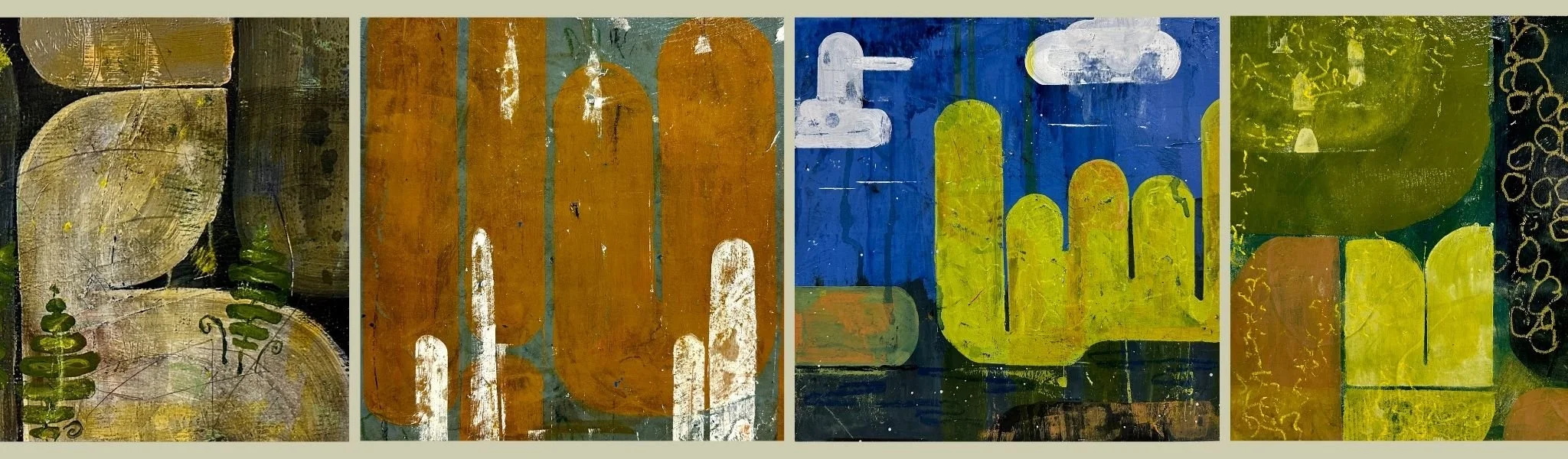
As an artist based in Washington, DC, I spend a great deal of time hiking in Rock Creek Park. It is a landscape I want to know intimately, because it is familiar and constantly changing.
Many artists are inspired by nature, but I believe, as artists, we cannot stop there. Part of my practice is to get curious about the inspirations that come to me and think as deeply as I can about why something holds my attention.
So what captures my attention in Rock Creek Park? Well, the way the light filters differently through the trees depending on the season; the shift in vegetation from autumn mushroom flushes to spring ephemerals; the way colors shift subtly over time— bright fall blue skies, green of moss, flash of red woodpecker, dark brown of winter mud, the shifting shades of the river. I’m also drawn to the slower processes - the season-by-season disintegration of a tree trunk by mycelium and insects, and the lichens imperceptively but inevitably turning rock back to soil.
The cumulative experiences of moving through the park again and again become visual memories that I carry with me into the studio, where paintings will develop often beginning with a simple color palette and attempt to manipulate the shapes I love to make into something like the overlapping visual memories The sense of depth that emerges is not spatial in a traditional sense, but temporal—a reflection of repeated visits, changing conditions, and sustained attention.
Viewers familiar with the park sometimes recognize something of their own experience in these paintings, while others respond simply to the mood or rhythm of the work. Both responses feel equally valid to me. The painting holds its origin, without requiring recognition.
Painting Rooted in the Desert Landscape
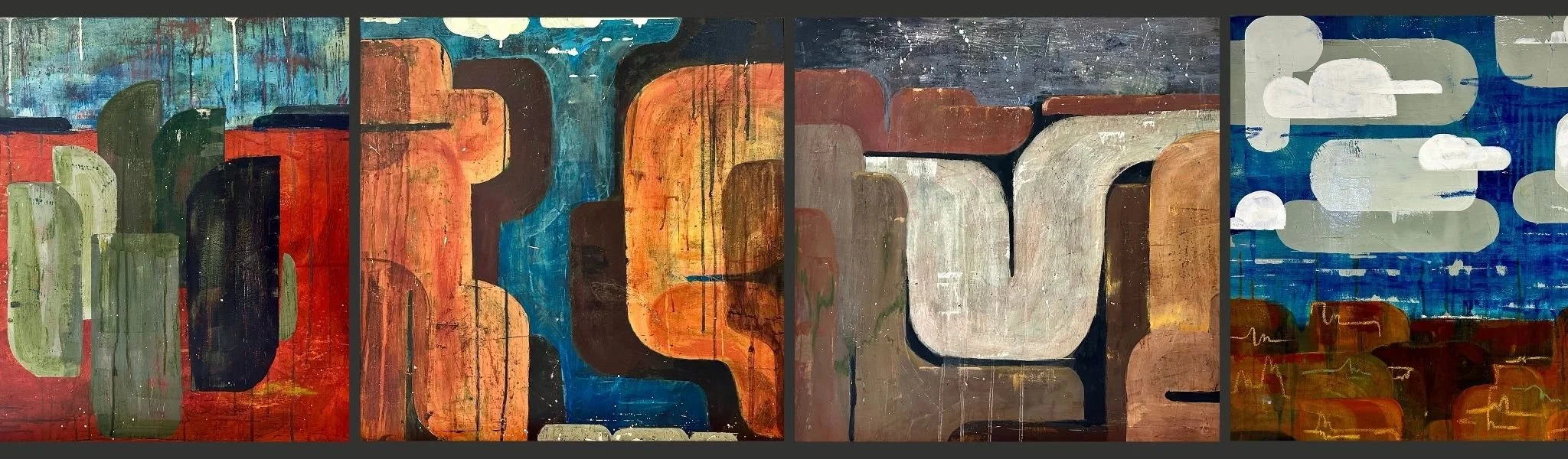
While my home is Washington DC, I spend several weeks every year in the American Desert West, particularly in Utah canyon country and other protected public lands. These places present a very different visual and emotional experience. Geological time speaks to me in exposed rock layers, eroded surfaces, the slow work of wind on water, and vast shifts in scale. Colors can be more intense here—reds, ochres, and mineral tones dominate, often punctuated by sharp contrasts of light and shadow.
In paintings informed by desert environments, I often work with thicker layers of paint and a more compressed sense of space. Forms may feel weightier or more structural, echoing the physical presence of stone and canyon walls. The process of building up and then sanding or scraping back layers becomes especially important, mirroring natural processes of erosion and accumulation.
While these paintings are grounded in specific places, they are not illustrations of them. Instead, they function as responses to the feeling of being in those environments—the scale, the silence, the awareness of deep time. Viewers may sense landscape, geology, or heat, even if they cannot name the place, and that ambiguity is intentional.
Fully Open-Ended Painting
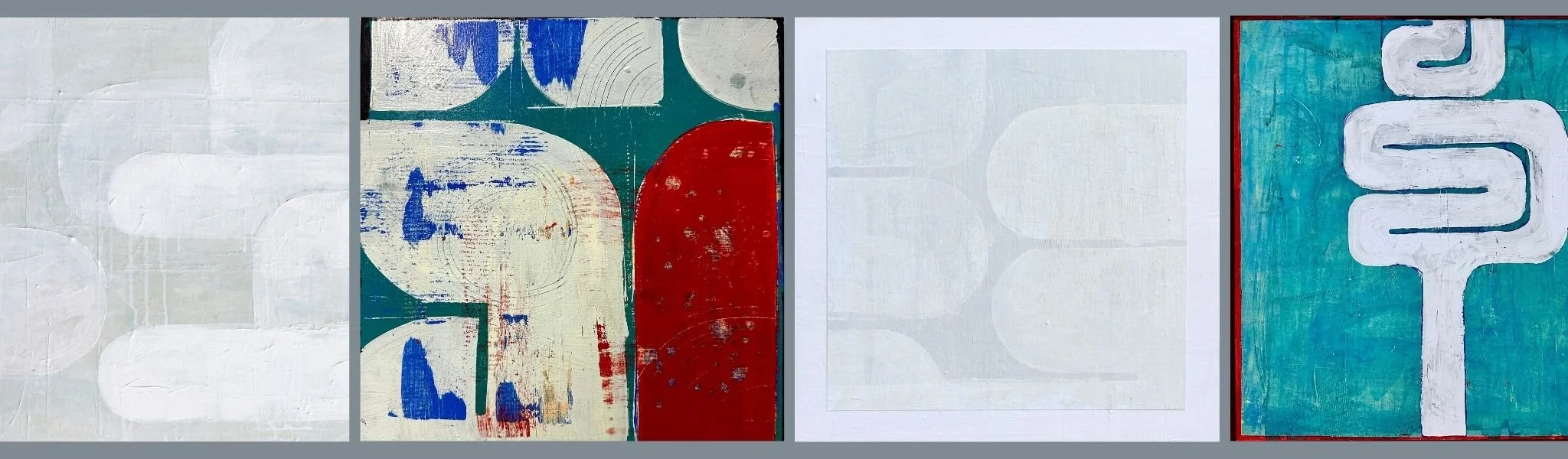
Alongside these place-informed works, I also create paintings that are not tied to any specific location. These pieces often begin with a question about color, balance, or form rather than with a memory of a landscape. They may develop from an intuitive palette choice, a repeated shape, or an interest in how certain colors interact when layered over time.
In these paintings, meaning is deliberately less anchored. There is no existing Place to uncover, no reference point to decode. Instead, the work exists as an object of visual and emotional experience. And while, as titles may reflect, I create with some internal concepts simmering while I compose, viewers of the paintings bring their own associations, memories, and responses to the surface, completing the work through their engagement with it.
I value this openness because it allows abstraction to function as a shared space between myself and the viewer, rather than a fixed message. What one viewer experiences as calm, another may experience as tension or movement. These interpretations do not compete with one another; they coexist.
How to Engage With Abstract Paintings
Understanding that my work moves between place-based reference and open interpretation can offer a helpful entry point for viewers. Rather than asking, “What is this a painting of?” I love when people ask, “What is this painting doing?” You might ask yourself “How do the colors interact? Where does my eye move and where does it linger? What emotions or memories surface while looking?” And your answers to those questions determine if and in what ways you enjoy the painting.
If a painting suggests a landscape or element of nature, that can be a starting place, but it does not need to be the destination. If a painting feels purely abstract, that openness is not a lack of meaning, but an invitation to participate more fully.
Holding Origin and Openness Together
Across my practice, abstraction is a way for me to hold specificity and openness at the same time. Some paintings carry the quiet imprint of the natural world; others emerge entirely from the material process itself (and whatever is percolating in my brain at the time). All of them are shaped by attention, repetition, and the slow accumulation of artistic decisions.
Ultimately, whether or not a viewer recognizes a place or idea within a painting matters less to me than whether the work creates space for reflection and curiosity. If a painting encourages someone to slow down, to linger, or to connect their own experiences to what they see, then it has done its work. You don’t have to like a painting to enjoy your interaction with it - in fact the interaction is the point.
In that sense, interpretation is not something to solve, but something to inhabit—much like a landscape itself.